Alera Group + Amwins
We're here as your trusted partner through industry change. Our goal is to help you win.

Alera Group + Amwins
We're here as your trusted partner through industry change. Our goal is to help you win.
Let's talk about how we can partner for your success.
Contact your Amwins broker or underwriter to discuss account needs.
If you don't have any Amwins relationship, please submit this form or contact:
Amwins delivers tailored solutions backed by

$44.5B
annual premium placements, including $372M with Alera Group.
2,200,000
submissions received annually
43,000
underwriter relationships
Areas of specialty

Data & Analytics
Amwins DNA is the wholesale industry’s most in-depth collection of insurance data. Our data is used to support our broker/underwriter teams and retail clients with market intelligence, benchmarking reports, and much more.

Amwins InstantQuote
Amwins IQ provides firm, bindable quotes from multiple carriers within minutes. Targeting small and middle market businesses, our digital solutions combine the ease and convenience of online quoting with the scale of the nation’s largest wholesaler.

International capacity
With boots on the ground in London and Bermuda, our colleagues at Amwins Global Risks and Amwins Bermuda have direct access and strong relationships within these key international marketplaces.
Market insights from Amwins
Our insight on emerging issues and trends in the marketplace gives you an advantage with your clients and helps you prepare them for what lies ahead.
A Look Ahead to Hurricane Season 2026
- The high likelihood of a moderate to strong El Niño is driving a below-average Atlantic season forecast, but even quieter seasons can produce severe losses.
- The Eastern Pacific is expected to see above-normal activity, increasing risks such as inland flooding, mudslides and secondary impacts from storm remnants.
- Preparation is critical: reviewing policy terms, stress-testing catastrophe plans and addressing coverage gaps are key as premium volatility and underinsurance persist in high-risk regions.
Although forecasts call for a quieter Atlantic season, elevated exposure values, record heat anomalies and an active Pacific basin mean insurers and brokers still face heightened catastrophe volatility. Preparedness, data-driven communication and coverage precision remain critical.
Climate and forecast outlooks
Atlantic Basin
The 2025 Atlantic hurricane season was marked by stark contrasts, with periods of calm interrupted by intense storm activity. For the first time since 2015, no hurricanes made landfall in the U.S. This was a welcome break from the devastation of 2024’s Hurricane Helene, costing $78.7 billion and the deadliest hurricane to strike the U.S. mainland since Katrina.
The 2025 season was ultimately categorized as above normal with 13 named storms, five hurricanes and four major hurricanes. Three of these hurricanes, Erin, Humberto and Melissa, reached Category 5 intensity, the second-most on record in a single season.
As we look ahead to 2026, the initial outlook predicts a departure from the intense 2025 season, with a below-average season overall. But varying water temperatures throughout the Atlantic offer mixed signals as to what we can expect, and a below-average season can still have a sizable impact.
The impact of El Niño conditions
The primary driver of 2026’s subdued Atlantic outlook is a developing moderate to strong El Niño, with NOAA giving an 82% chance of it persisting through summer. El Niño tends to:
- Increase wind shear across the tropical Atlantic, disrupting storm formation
- Support enhanced activity in the eastern and central Pacific
However, warmer-than-average waters in the western Atlantic contradict this signal slightly, meaning localized intensity spikes are still possible. The CSU forecast team will continue to monitor these contrasting indicators ahead of peak season (August–October). Their initial April report is historically less accurate than the ones that follow, so NOAA midseason updates will be pivotal for adjusting reinsurance placements, property renewals or catastrophe bonds.
By contrast, La Niña years tend to flip that balance: the Atlantic becomes more active while the Pacific quiets. In recent decades, La Niña years like 2020 and 2021 produced some of the most intense Atlantic activity on record. But El Niño seasons can still surprise. Hurricane Andrew (1992) and Hurricane Idalia (2023) both struck during El Niño years, proving it only takes one major hurricane to make a season devastating.
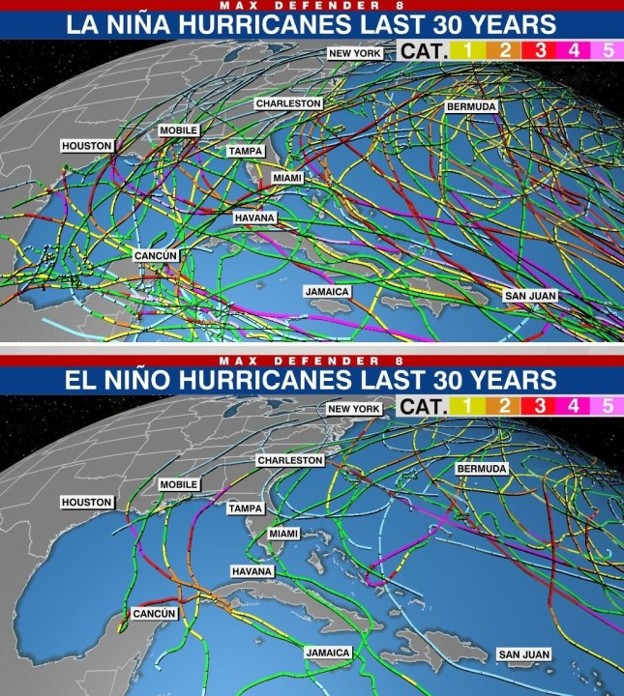
La Niña produces 3 times more hurricanes than El Niño, Max Defender 8 analysis finds | WFLA
East Pacific
NOAA’s 2026 Eastern Pacific Hurricane Outlook points to an above-normal season, driven by the same El Niño warming the Pacific Ocean. Predictions include:
- Named storms: 15 - 22
- Hurricanes: 9 - 14
- Major Hurricanes: 5 - 9
- Accumulated Cyclone Energy (ACE): between 120% - 190% of the median
While strong tropical systems rarely make landfall along the U.S. West Coast, due to cold currents and persistent high pressure, storm remnants can be steered north by the jet stream, unleashing flash floods, mudslides and debris flows on parched terrain. For risk managers, this means accounting for remnant moisture, inland flood exposure and wildfire burn‑scar vulnerabilities when planning coverage and catastrophe mitigation efforts.
This contrasts sharply with El Niño’s damping effect on the Atlantic, underscoring the global see-saw interaction between basins. NOAA emphasizes that landfalls cannot be predicted seasonally but cautions that any year, active or quiet, can yield a disaster.
Impacts of El Niño vs. La Niña
| El Niño Years | La Niña Years | |
| Atlantic Conditions | Suppressed hurricane activity due to stronger upper-level wind shear | Enhanced hurricane activity with weaker wind shear |
| Pacific Conditions | Increased hurricane activity, especially in Eastern & Central Pacific | Fewer hurricanes, shorter duration storms |
| Typical Storm Tracks | More storms in East Pacific approaching Mexico and Hawaii | More storms forming in Atlantic and Caribbean, approaching U.S. Gulf and East Coast |
| Historical Examples | Hurricane Andrew (1992) Hurricane Idalia (2023) | Hurricane Harvey (2017) Hurricane Laura (2020) |
Preparedness and claims best practices
Preparation begins long before a storm even begins to form. Amwins’ property specialists recommend that insureds and brokers review all policy language, especially deductibles and exclusions, well in advance of hurricane season.
Even if a storm doesn’t become a hurricane, severe convective storms and other short-duration events can still lead to billion-dollar claims. Partner with your Amwins broker network to stress‑test catastrophe plans before NOAA’s August update and help ensure that your portfolios are aligned with current El Niño driven risk conditions.
Additional Considerations as You Prepare for 2026 Storm Season
- Premium volatility: Heavy 2024–2025 losses increased property premiums 15% to 25% in coastal markets.
- Flood coverage gaps: Both the east coast of Florida and Harris County, TX remain severely underinsured under NFIP caps of $250k (residential) and $500k (commercial).
- Claims processing: An emphasis on digital reporting tools and pre-storm mitigation is speeding post-event recovery client advisory.
- Reinsurance dynamics: Global reinsurers are shifting focus to multi-year resilience programs and data-driven exposure analysis to help manage El Niño related volatility.
We help you win
Colorado State University and NOAA’s early outlooks suggest a less active Atlantic but vigorous Pacific storm season. Yet the key message remains consistent: Preparedness is everything.
Quiet forecasts can change, and one major storm is all it takes to make history. Now is the time to:
- Revisit your clients’ coverage and review mitigation plans
- Work proactively with a wholesale partner to help ensure adequate protection before the next storm forms
Amwins property brokers are here to help. Through Amwins DNA, the industry’s most in-depth collection of E&S insurance information, our team of specialists have access to proprietary weather events reports, enabling them to pinpoint which accounts have locations that could be in the path of an upcoming storm and proactively reach out, helping you protect insureds’ assets by preparing them for tropical storms and hurricanes.
Our in-house modeling team utilizes RMS (Risk Management Solutions) and AIR Worldwide (a division of Verisk Analytics) to produce a variety of reports, including but not limited to:
- U.S. Hurricane Reports: These reports include PMLs (Probable Maximum Loss), AALs (Average Annual Loss) and standard deviation metrics, with considerations for storm surge and demand surge impacts.
- Severe Thunderstorm Reports: These reports also include PMLs and AALs, addressing tornado and hail risks.
- Flood and Wildfire Reports: Inland flooding and wildfires in the western states are included in these reports, with similar metrics and considerations for demand surge.
- Caribbean and Mexico Reports: Earthquake and hurricane reports for these regions are also generated, focusing on PMLs and AALs.
Working with our property specialists gives you a distinct advantage. When you tap into our network, you get 1,100+ industry-fluent professionals who collaborate on risks to provide custom insurance solutions.
Contact your Amwins broker today.
- Jess Zuiker, CPCU, ARe, VP and Amwins’ Assistant National Property Practice Leader
- Property
- Property