



As pricing pressures persist in the casualty market, particularly in commercial auto, insureds face limited options. This is especially true for civil construction contractors with large fleets, adverse loss experience and/or operations in litigious states. For these buyers, traditional insurance structures may no longer be sufficient.
Exploring alternative strategies that offer greater control over cost and coverage is just one way civil construction contractors can step outside conventional program design. These models involve collaboration between insureds, brokers and carriers – combining underwriting creativity with thoughtful risk allocation.
A changing market
Commercial auto has been one of the most persistently challenged lines in the casualty market, driven by social inflation, nuclear verdicts and aggressive litigation funding as well as rising vehicle repair and medical costs.
Civil construction contractors, which typically operate large, mixed fleets across multiple jurisdictions, are among the most exposed, particularly those with operations in states with plaintiff-friendly legal environments.
The result has been steep rate increases, shrinking capacity and in some cases, carriers exiting the segment entirely, leaving brokers and their clients with fewer viable options each renewal cycle.
A new perspective
From an underwriter’s point of view, the result is a market that has moved beyond simply pricing risk. In the past, the approach to coverage centered around the amount of capacity that could be provided. Now, capacity is no longer a function of market appetite. It is earned through risk quality.
This requires a mindset shift on both sides of the table.
- Underwriters can help insureds understand which investments materially improve their risk profile. Instead of presenting telematics or AI-powered camera systems as underwriting credits, insureds can be shown how these tools can be considered signs of a management team’s commitment to reducing claim frequency and severity.
- Insureds can view technology as a way to not only reduce accidents, but protect insurability. In a market where excess capacity remains disciplined, companies that embrace data-driven fleet management will be better positioned during renewals, attract broader competition and differentiate themselves from peers.
The future of fleet underwriting won’t be defined by who can offer the most capacity; it will rely on the partnerships between insureds and insurers that take advantage of technology, transparency and continuous risk improvement to make those limits sustainable.
A non-traditional approach
For contractors with $500,000 or more in annual commercial auto premium, a demonstrated commitment to safety and a willingness to treat insurance as a risk management function rather than a commodity purchase, there are several alternatives worth evaluating."
- Large structured deductible programs can shift retained losses below an agreed attachment point back to the insured, creating direct financial incentive for risk management.
- Single-parent captives may provide even greater control, allowing the insured to retain premium, invest reserves and build equity over time.
- Group captives offer benefits similar to single-parent captives to contractors who may not have sufficient premium volume to support a standalone structure.
- Risk retention groups, chartered under federal law, are another option for homogeneous groups of contractors seeking stable, long-term capacity.
The first step for any contractor considering any of these non-traditional approaches is getting their data in order. Underwriters and alternative structure providers require clean, multi-year loss runs with full development, ideally five or more years. They will also need details on fleet composition, driver safety records, telematics data and a clear picture of where and how vehicles are operated. The better the data, the more leverage a client has in structuring a solution.
Locking in stability
Multi-year structures, both single-line and multi-line, are increasingly relevant in today’s volatile market.
- A multi-year single-line program locks in terms and pricing for commercial auto over two or three years, providing budget certainty and insulating the insured from mid-market disruptions.
- A multi-line multi-year program extends that logic across multiple casualty lines, including auto, general liability and workers’ compensation, creating a unified structure that can optimize aggregate retentions, reduce frictional costs and simplify the renewal process.
These alternative structures tend to work best for a specific profile: meaningful premium volume, strong safety performance and an active approach to risk management. For them, the difference in long-term cost and control can be substantial.
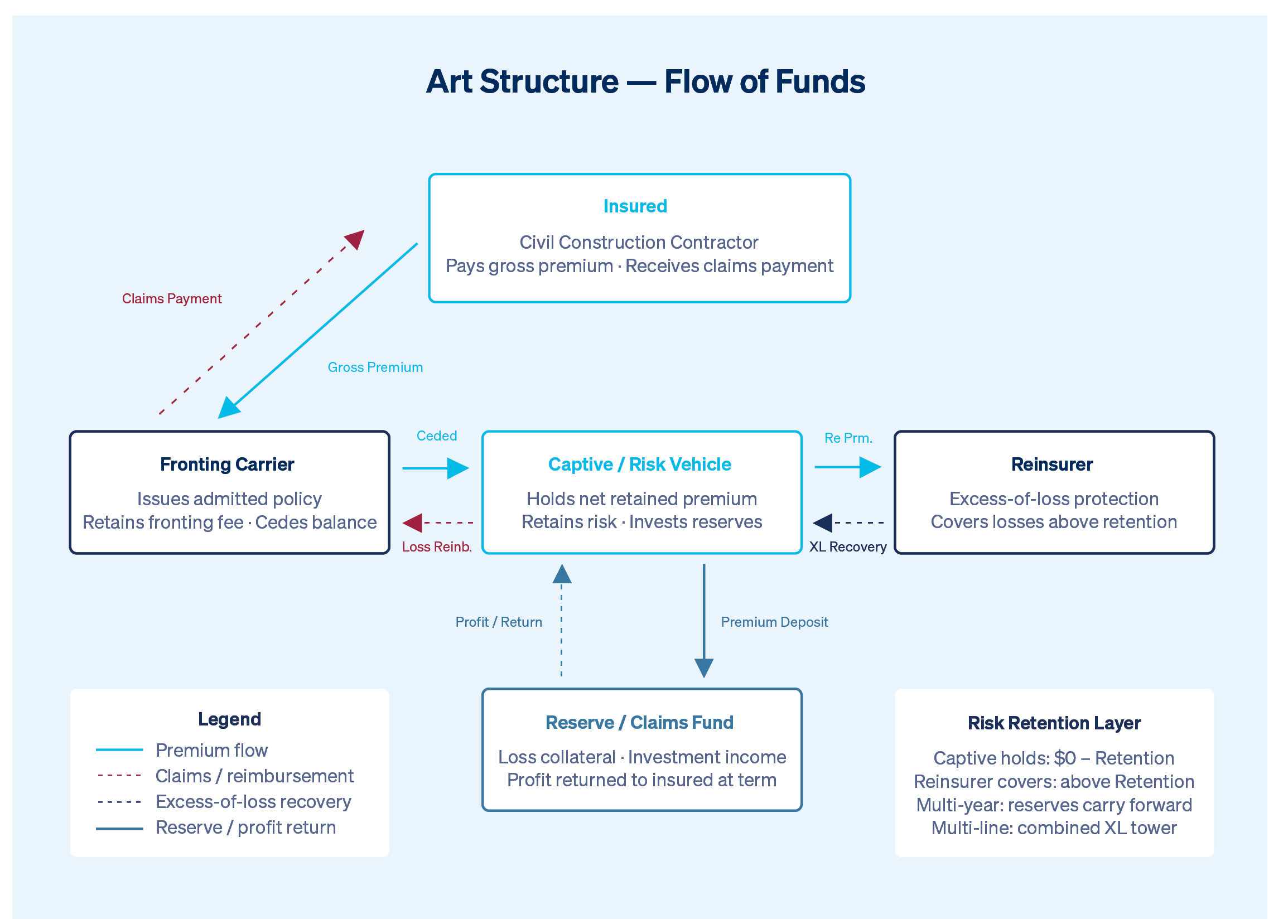
The diagram below shows how these alternative structures move money and risk. Premium from the insured funds a captive or risk-retention vehicle, which retains and invests the layer of loss it's designed to hold, while a reinsurer assumes everything above that retention through an excess-of-loss layer.
In a multi-line, multi-year program, that same framework widens to span several coverage lines and policy terms — allowing reserves to build and profit to return to the insured over time.
Source for chart: www.artiorisk.com
These evolving coverage strategies involve more than simply adjusting limits or increasing deductibles. They reflect a different way of thinking about risk. Even in today’s challenging market, for clients willing to take a more active role in managing their exposures, the result can be a more sustainable and cost-effective program.
We help you win
Solving challenging risks takes more than a standard approach. It requires deep market knowledge, technical fluency and the ability to clearly communicate structure and value to both clients and carrier partners. There is no “one-size-fits-all” solution. Finding a tailored approach depends on understanding both the mechanics of the market and the specific needs of each client.
As the landscape continues to evolve, brokers must stay agile and solution-focused. With the right expertise in place, even the most complex auto liability risks can be addressed with confidence and creativity.
The Amwins construction insurance practice leverages the expertise of specialists around the country to meet the unique needs of various construction-related entities or insureds. We deliver trusted consultation, market access and creative program structures to place coverage for even the most complex and layered accounts, providing value-added resources, unmatched service and expertise every step of the way.
Contact your local Amwins broker today to learn more.